36 results found
Pick the right Profile Hub profile for the job
Which MCP Profile Hub system profile fits which developer or content job, why narrow profiles beat the product profiles, and when to build your own.
Revalidate, prime or redeploy? Picking the right cache lever on Launch
Launch gives you three ways to get fresh pages to visitors. Here is what each one costs, when to use it, and a decision flow for picking one.
Five Developer Hub gotchas that bite on day two
Five Developer Hub app problems that show up after launch, from wiped secrets to silent 401s, with the cause and the fix for each.
Releases, bulk publish and nested reference publishing, explained
Three ways to get many entries live together in Contentstack, what each one is for, and the API and CLI calls behind them.
Every csdx command is a plugin
The Contentstack CLI is a thin core with plugins doing all the work. Here is how that works in 2.x, what ships bundled, what is opt-in, and five recipes.
How MCP Profile Hub enriches tools for your stack
MCP Profile Hub fills generic tool schemas with your stack's content types, locales, branches and more. Here is how it works, what it costs, and why.
Client, static, server or edge? Choosing a Personalize architecture
CSR, CSR with SSG, SSR and SSR at the edge compared for Contentstack Personalize, on flicker, caching, cost, complexity and SEO.
Taxonomies are your query layer
How developers.contentstack.com rebuilt its learning content on four taxonomies, learning paths and agent-ready markdown, and why intent and level matter most.
We don't test our MCP profiles. We test the agent.
How we test MCP Profile Hub for AI agents: a deterministic tool matrix plus behavior evals for grounding, safety, and correct tool use, gated on every change.
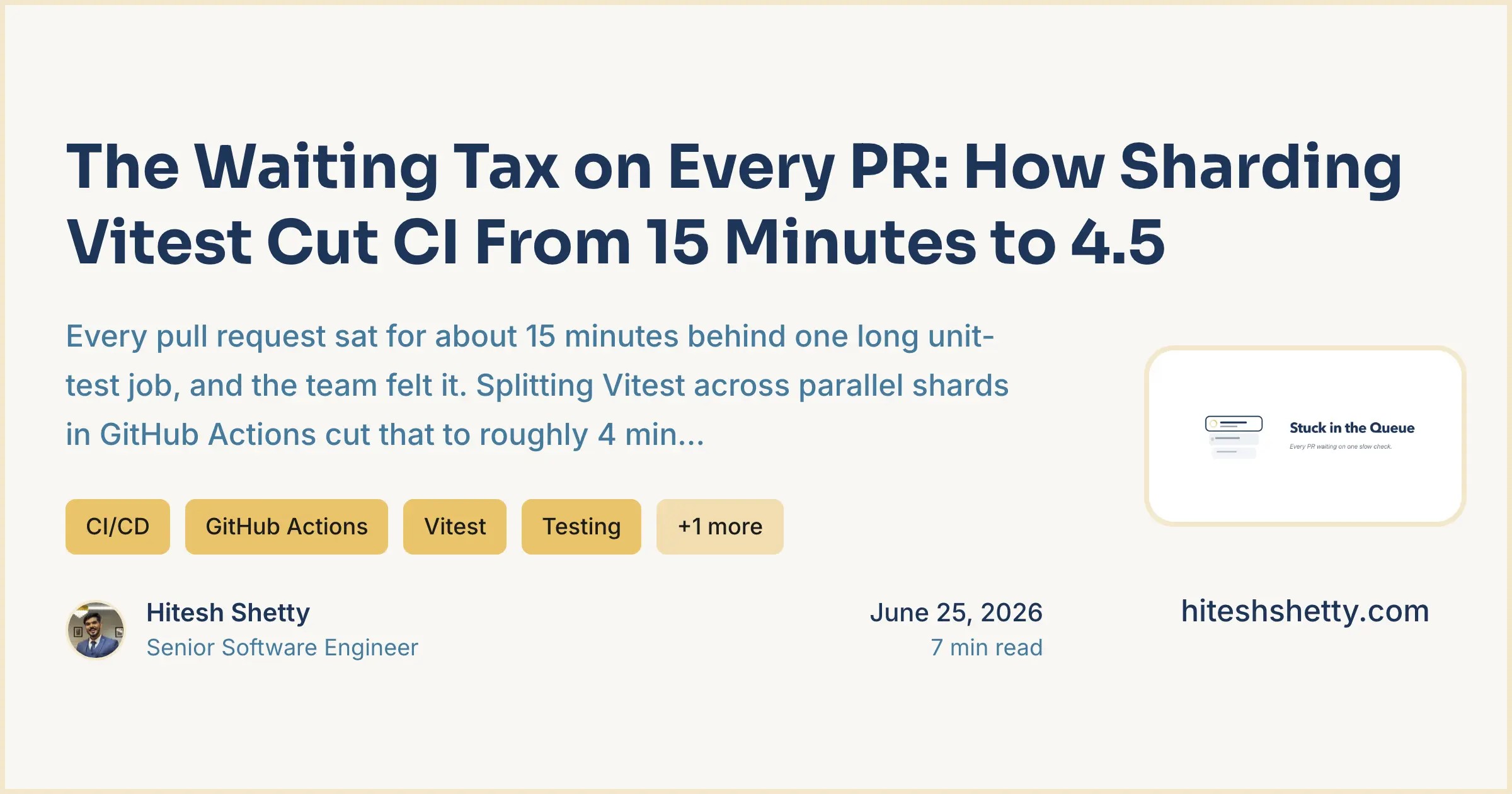
The Waiting Tax on Every PR: How Sharding Vitest Cut CI From 15 Minutes to 4.5
Splitting Vitest test runs into parallel shards with GitHub Actions slashed continuous integration (CI) wait times from 15 minutes to just 4.5 per pull request. This article details the simple configuration changes and workflow optimizations that brought dramatic productivity gains for the whole team.

Where AI Should Run: Chat Apps, Local LLMs, MCP, APIs, CLIs, and AgentOS
A visual guide to understanding where AI should run, including local LLMs, chat apps, coding agents, MCP, APIs, CLIs, AgentOS, and BYO LLM architectures. Learn how context, tools, permissions, and governance shape the right AI workflow.
Responsibilities of Skills, MCP, CLIs, and APIs
Clarifies responsibilities across Skills, MCP servers, CLIs, and APIs for AI dev workflows—keeping auth, permissions, and audit boundaries clean.

Migrate Contentful to Contentstack in 10 minutes. Content and Code.
Launch an AI-guided tool to migrate from Contentful to Contentstack, moving content and rewriting app code via deterministic CLI steps.
AI will not live in one place, but trust has to
This article discusses the tension between rapidly expanding enterprise AI capabilities and the need for strong governance, introducing a two-layer architecture: off-platform AI for experimental reach and on-platform AI for trusted, governed execution. It explains how combining both layers allows organizations to benefit from flexible, distributed AI while maintaining oversight, brand integrity, and risk management.
Understanding how Contentstack CMS, Personalize, and Lytics work together
Learn how Contentstack CMS, Lytics, and Personalize work together to deliver real-time personalization using structured content, user data, and edge decisions.

The future of software is bespoke
This article explores why generic SaaS dashboards are becoming outdated as modern APIs, SDKs, scaffolding, and AI-assisted development enable teams to quickly build bespoke interfaces tailored to their exact workflows. It discusses how platforms should provide core infrastructure while teams take ownership of the experience layer, and examines both the benefits and trade-offs of this new paradigm.
The Architecture of Intelligent Retrieval : Part I
Learn how Mastra-style workspaces and markdown skills (SKILL.md + references) provide structured context for Agentic RAG agents and tools.
Code is craft now, not labor
This article explores how advances in AI and automation have transformed programming from a required task for software production into an act of creative expression, much like knitting transitioned from necessity to craft. The author discusses the enduring value of foundational development skills and predicts a future where coding by hand is a rewarding choice rather than a job requirement.

Contentstack agent skills security policy
This policy defines the minimum security requirements for building, publishing, and maintaining Agent Skills within the Contentstack ecosystem. It protects users, content, and systems from prompt injection, unsafe markdown rendering, and model hallucinations.
Agents are users now and this website is ready
AI assistants are part of every developer's workflow. Here's how developers.contentstack.com serves them: markdown for every page, full.md documents, llms.txt, agents.md and sitemap.md.